
For your team · Wrap
Time tracking for consultancies
Bring research, workshops and delivery into one client-project record, with the context needed to review an engagement.
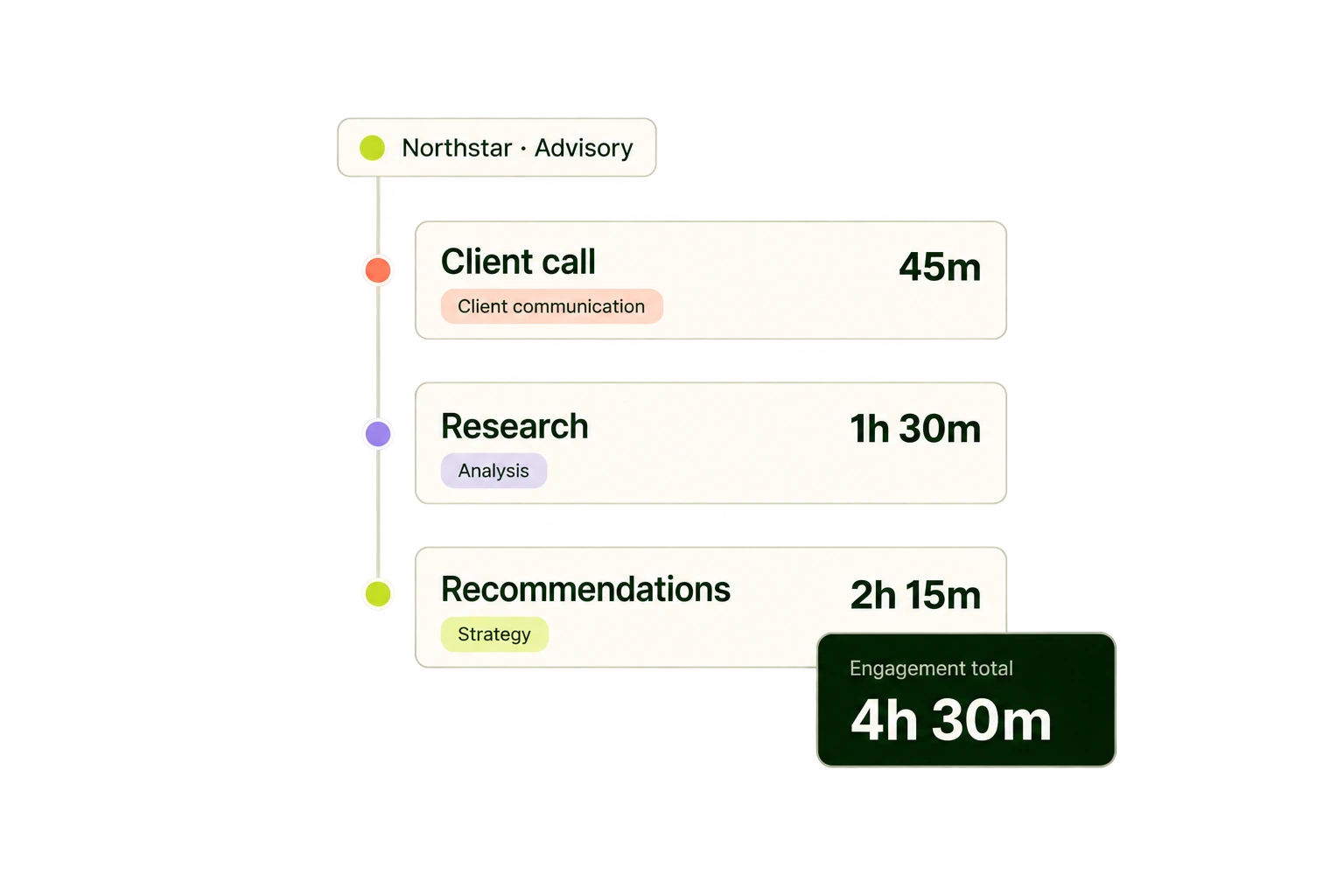
Built around your working day
A consulting engagement includes preparation and synthesis as well as the visible meeting. A timesheet that records only workshop hours hides much of the work needed to produce a useful recommendation.
What consultancies can track
Research and preparation
Client workshop
Synthesis and recommendations
Close the gaps
before the week moves on.
Start a timer for a focused session, add a known block manually, or use the guided day wrap to account for time still missing. The final record connects to the same projects and reporting view.
For consultancies, that means the day can include research and preparation, client workshop, and synthesis and recommendations without requiring everyone to use an identical tracking habit.
Explore the daily wrapWhere did your time go today?
Adjust the allocations to see how a day could add up.
Illustrative allocation, initially six hours, not a recommended schedule or a benchmark. Adjusting this example does not save time or create an account.
A sensible first week
Start with one engagement.
- 01
Create phases for discovery, analysis and delivery when those stages have separate budgets or review points. Keep preparation tied to the engagement it supports.
- 02
Invite a small group with different delivery responsibilities. Agree what a useful description looks like and when the daily record should be complete.
- 03
Compare the time spent preparing, delivering and following up. Use that mix to improve the next estimate without assuming every hour is separately billable.
- Start with
- One engagement
- Include
- Contributors and a reviewer
- Look for
- Complete, explainable entries
Questions worth asking.
Should preparation be billed separately?
That depends on the engagement agreement. Record it accurately first, then apply the agreed billable treatment rather than omitting it from the cost view.
What should we keep in our existing tools?
Wrap does not replace proposal development, client contracts or a resource schedule for future engagements.
How should we judge the pilot?
Review whether entries are complete, projects are selected consistently and the report supports your next scope or budget conversation. For consultancies, the useful result is an explainable record of the work, not a higher number of logged hours.
How does pricing work for the team?
Wrap charges per company in active-member bands. The Free plan covers up to 10 active members; the paid bands are Team for 11–99 and Business for 100+. All self-service plans share the same features.
A clearer record starts
with one working day.
Try the workflow with your own team. Free for up to 10 active members.